

 Pay Online
 Client Access


When margins get tight, cutting costs is usually the first lever an owner pulls. It is also one of the easiest to get wrong. Some cuts make a business leaner and stronger. Others save money this quarter and cost far more later, in lost customers, slower decisions, or a team stretched too thin to keep up.
The difference usually comes down to asking the right questions before anything gets cut. Here is a simple framework for deciding which expenses to reduce, which to eliminate, and which to protect.
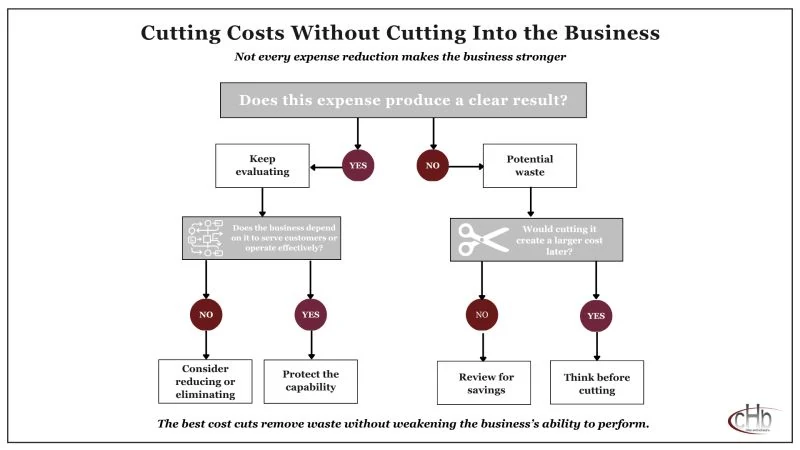
Start with one question: does this expense produce a clear result?
Every expense should be able to answer for itself. If you can point to what it produces, whether that is revenue, customer retention, efficiency, or compliance, it deserves a closer look before you touch it. If you cannot point to anything, it is potential waste.
That single question splits your expenses into two very different conversations, and each one needs a different follow-up.
When the answer is yes: does the business depend on it?
Producing a result is not the same thing as being essential. The next question is whether the business depends on that expense to serve customers or operate effectively.
If it does not, consider reducing or eliminating it
Some expenses produce a result but are not core to how the business runs. A software add-on that is nice to have, a marketing channel that brings in a little business but is not a real driver, or perks and subscriptions that made sense a few years ago all fall into this bucket. These are fair game. Scale them back, renegotiate them, or cut them entirely.
If it does, protect the capability
This is where cost cutting most often goes wrong. The people who hold your customer relationships, the systems that keep orders moving, and the financial reporting you rely on to make decisions are capabilities the business cannot operate without. Protecting a capability does not mean the cost is untouchable. You can still renegotiate a contract or find a more efficient way to deliver the same result. But the goal is to keep the capability intact, not to weaken it for a short-term savings.
Losing a capability is often more expensive than it looks on paper. We broke down what that can mean in what it actually costs when a key person leaves.
When the answer is no: would cutting it create a larger cost later?
An expense that does not produce a clear result is a strong candidate for cutting, but not an automatic one. Before you cut it, ask whether removing it would create a bigger cost down the road.
If it would not, review it for savings
This is the true waste in most businesses. Unused software licenses, duplicate tools that do the same job, contracts that auto-renew without anyone reviewing them, and vendor services nobody remembers signing up for. These are the easiest wins in any cost review, and they rarely hurt the business when they go.
If it would, think before cutting
Some expenses never show up as a result on a profit and loss statement until they are gone. Preventive maintenance, insurance, compliance work, employee training, and keeping your books clean all fit here. Skip them and the bill usually comes back larger, in the form of downtime, penalties, missed deductions, or an expensive cleanup project. These deserve a careful look before anything changes.
Where well-meaning cost cuts go wrong
Even owners who take a thoughtful approach can fall into a few common traps:
- Cutting across the board. An equal percentage cut to every department treats essential capabilities and real waste exactly the same.
- Cutting the finance function first. Losing visibility into your numbers makes every other decision harder. If a full-time hire is not in the budget, a fractional CFO can keep that capability in place at a different cost structure.
- Ignoring timing. A cut that looks fine on an annual basis can still create a cash crunch at the wrong time of year. It is worth checking whether your cash flow is ready for your busiest season before making changes.
- Counting the savings without counting the consequences. Every cut has a tradeoff. The savings are easy to measure. The impact on customers, employees, and operations takes more work to see.
Make expense reviews a habit, not an emergency
The best time to reduce business expenses is before you have to. Reviewing your costs on a regular schedule, rather than only when cash is tight, gives you room to make thoughtful decisions instead of rushed ones. Walk each major expense through the same questions, assign someone to own the follow-up, and keep track of what happened after each change so the next review gets easier.
The best cost cuts remove waste without weakening the business’s ability to perform.
Get a second set of eyes on your expenses
It is hard to see your own expenses clearly when you are in the middle of running the business. cHb Advisors works with lower mid-market businesses to review where the money is going, separate real waste from essential capabilities, and build a plan that strengthens the business instead of thinning it out. Contact us to start the conversation.
