

 Pay Online
 Client Access


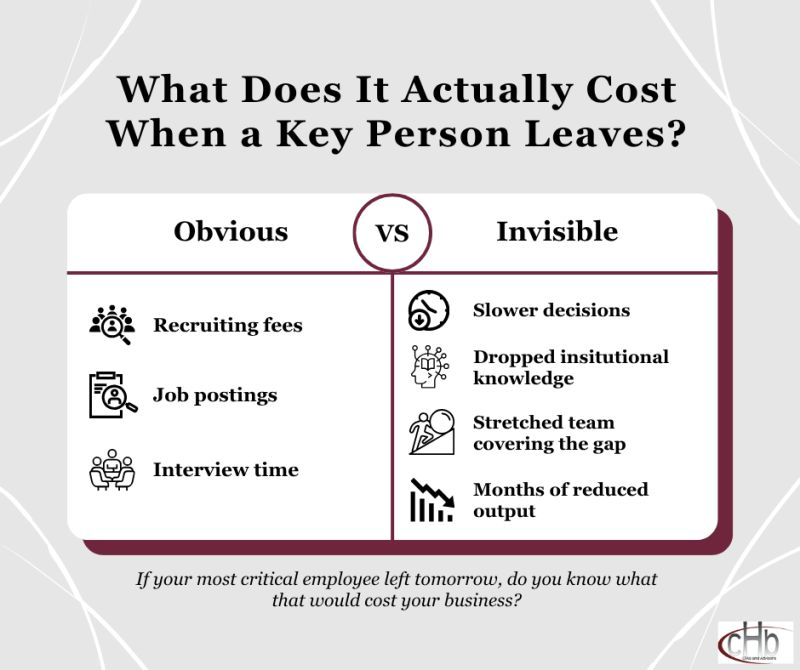
If your most critical employee left tomorrow, do you know what that would cost your business? Most owners can guess at the obvious line items. Far fewer have priced out what actually happens in the months after.
The obvious costs are the easy part to budget for
Recruiting fees, job postings, and the hours your team spends sitting in interviews all show up on a spreadsheet somewhere. They are real money, but they are also the smallest part of the bill. According to the Society for Human Resource Management, the cost of replacing an employee can run anywhere from 50 percent to 200 percent of their annual salary, depending on how senior or specialized the role is. For a key employee, that number lands at the high end of the range, not the low end.
The invisible costs are the part that actually hurts
This is where most cost estimates stop too early. When a key person walks out the door, a business typically absorbs four costs that never make it onto an invoice:
Decisions slow down because the person who used to make the call, or at least gather the information behind it, is gone. Institutional knowledge drops out of the business entirely, the vendor relationships, the client preferences, the reasons things are done a certain way that were never written down anywhere. The remaining team gets stretched thin covering the gap on top of their own workload, which quietly raises the odds that someone else leaves too. And output stays reduced for months, not weeks, while a replacement ramps up to even partial productivity.
That combination is why real-world cases often look worse than the math suggests. It is not unusual for one departing employee’s responsibilities to require two or three new hires to fully cover, because the original role had quietly absorbed work that was never formally assigned to it.
Where this shows up in your own finance function
Owners who think carefully about key person risk in operations or sales often overlook it in their own accounting and finance function. If one bookkeeper, controller, or office manager is the only person who truly understands your books, your margins, and your cash position, that is a key person risk sitting inside your financial reporting right now.
This is one of the reasons closely held businesses move toward an outsourced CFO relationship rather than depending on a single in-house hire for financial leadership. The knowledge lives with a team and a documented process, not inside one person’s head, so a vacation, a resignation, or a surprise departure does not leave you guessing at your own numbers.
If your most critical employee left tomorrow, you should be able to answer what it would cost, and have a plan for the gap, before it happens rather than after.
