

 Pay Online
 Client Access


Most financial problems do not arrive as a surprise. They build quietly, one month at a time, while the business looks busy and the top line looks healthy. By the time the problem has a name, the options for fixing it have usually gotten narrower and more expensive.
The good news is that the early signals are almost always there. They just tend to show up in places owners are not looking, or they get explained away as a one-time thing. Here are five we pay close attention to with the lower mid-market companies we work with.
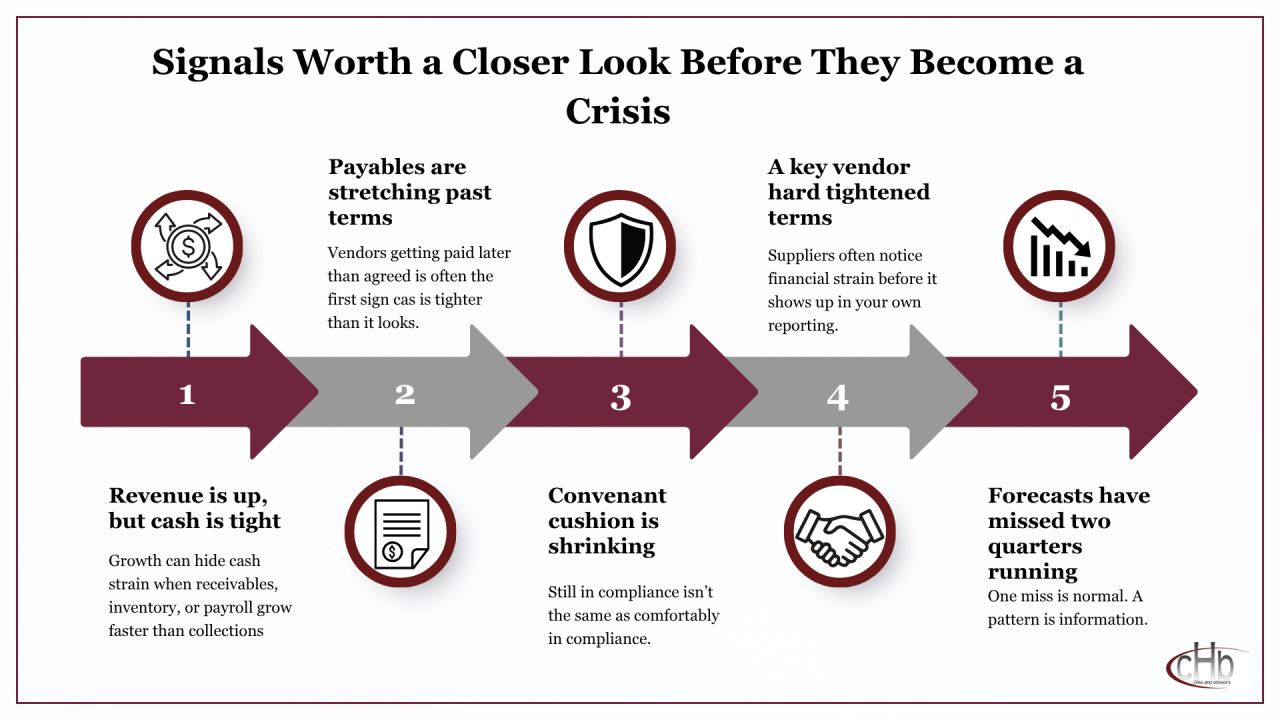
1. Revenue Is Up, but Cash Is Tight
This one catches a lot of owners off guard, because it feels like it should not be possible. Sales are growing, the team is busy, and yet there never seems to be enough cash in the account.
Growth uses cash. When receivables, inventory, or payroll grow faster than collections, the business can be profitable on paper and still feel squeezed every week. We dig into this in more detail in why profitable businesses still go broke, but the short version is this: if growth and cash are moving in opposite directions, it is worth finding out why before the gap gets wider.
2. Payables Are Stretching Past Terms
Paying a vendor a little late now and then is not a crisis. But when it becomes the normal way of managing cash, it is often the first sign that cash is tighter than it looks.
Stretching payables can feel like a smart short-term move. It keeps cash in the business a little longer. The problem is that it hides the real issue instead of solving it, and it tends to grow. A few days late turns into a few weeks, and eventually vendors start to notice.
3. Covenant Cushion Is Shrinking
If your business has a line of credit or term loan, you likely have debt covenants to meet. These are the financial ratios your lender expects you to stay within.
Still in compliance is not the same as comfortably in compliance. If the room between where you are and where the covenant sits has been getting smaller each quarter, that trend matters, even if you have not crossed the line. A covenant breach can limit your options quickly, and lenders are generally much easier to work with when you bring a concern to them early rather than after the fact.
4. A Key Vendor Has Tightened Terms
Suppliers see a lot of businesses, and they often notice financial strain before it shows up in your own reporting. If a key vendor has shortened your terms, lowered your credit limit, or asked for payment up front, take it seriously.
Sometimes it is about the vendor’s own situation. But often it is a signal that they are seeing something in your payment pattern that you have not fully addressed yet. Either way, it puts more pressure on your cash, which can make the other warning signs on this list worse.
5. Forecasts Have Missed Two Quarters Running
One miss is normal. Every business has a quarter where a big deal slips, a cost runs higher than expected, or demand shifts.
A pattern is information. When forecasts miss two quarters in a row, it usually means one of two things. Either something in the business has changed and the forecast has not caught up, or the forecasting process itself needs work. Both are worth fixing, because decisions about hiring, spending, and borrowing all depend on having numbers you can trust.
What to Do If You Recognize These Signals
Seeing one of these signs does not mean your business is in trouble. Seeing two or three at the same time is a good reason to step back and take a closer look. A few places to start:
- Build a rolling cash forecast. Looking ahead week by week gives you time to act instead of react. If seasonality is part of the picture, our post on getting your cash flow ready for your busiest season is a good place to begin.
- Review your receivables. Find out who is paying slowly and why, and tighten up collections where you can.
- Talk to your lender early. If covenant cushion is getting thin, a proactive conversation goes much further than a surprise.
- Look at costs with a clear eye. Not every cut is a good one. Our guide on reducing business expenses without cutting too deep walks through how to find savings that do not hurt the business.
- Get an outside perspective. It is hard to see patterns in your own numbers when you are running the business every day.
Catch It Early
The businesses that get through a tight stretch well are usually the ones that saw it coming. Having someone watching the numbers, tracking trends, and asking the right questions can make the difference between a course correction and a crisis. That is a big part of why many owners decide it is time to bring in a fractional CFO.
If any of these signals sound familiar, we are happy to talk it through. Learn more about our accounting and CFO services or contact cHb Advisors to start the conversation.
