

 Pay Online
 Client Access


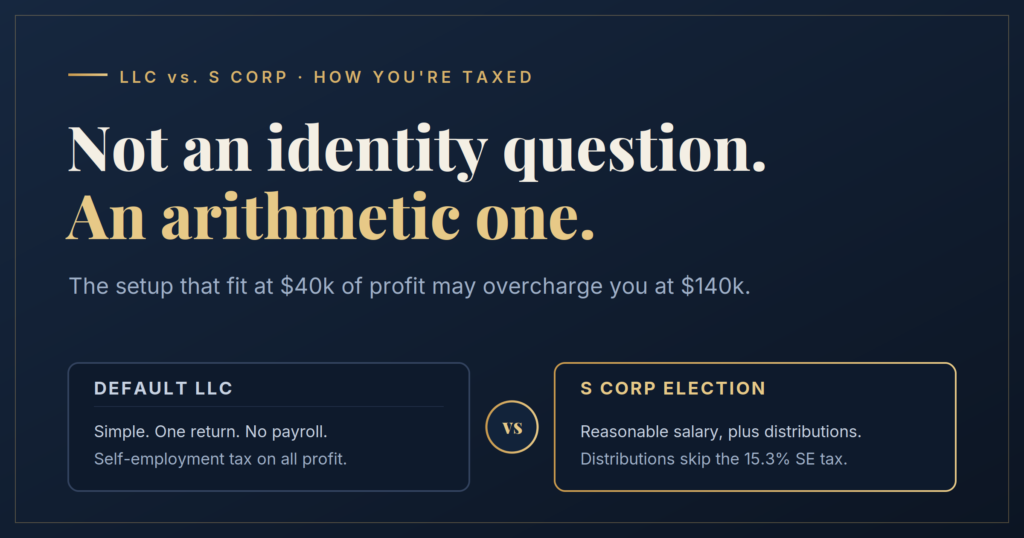
When getting into making a business official, one of the first questions that pops up is “should I be an LLC or should I make my company an S corp?” You would be surprised how many times we hear that. It’s a valid question, but the terms for both could not be more different. By the end of this article, you’ll realize that they aren’t alternatives to your business. They are different beasts for different types of businesses, and your needs will dictate which is better for you more than the cost.
First, let’s talk about the LLC. An LLC, or limited liability company, is a legal structure created under state law. This means that your business can protect your personal assets by separating your personal finances from business finances. S corporation, on the other hand, is a tax status you select, not a different kind of company. This means that many LLCs are taxed as S corps, and most small S corps are legally LLCs. So the question you should be asking isn’t “LLC or S corp,” but “how should my LLC be taxed?”
How your LLC is taxed if you do nothing
Out of the box, the IRS doesn’t really see your LLC at all. If you’re the only owner, the business’s profit lands directly on your personal tax return. If you have partners, the LLC files a partnership return and the profit flows through to each of you. Either way, here’s the part that matters: the full net profit is generally subject to self-employment tax, which covers Social Security and Medicare, on top of your regular income tax. That’s roughly 15.3% stacked on top of whatever income tax bracket you’re in.
Now, before you panic about that number, we want to be fair to the default setup. It’s simple. There’s no payroll to run, no extra tax return to file, and very little that can go wrong. For a newer business, a side business, or a business with modest profits, the default LLC taxation is often exactly the right answer. We tell owners this all the time, even though it means less work for us.
What the S corp election actually changes
Here’s where the S corp comes in. When your LLC elects S corporation status, you stop being just an owner and become an employee of your own company too. You pay yourself a reasonable salary, and that salary goes through payroll with normal payroll taxes, just like any other job. Whatever profit is left over after your salary flows through to you as distributions, and here’s the magic word: distributions are not subject to self-employment tax.
Let’s put real numbers on it, because this is easier to see than to explain. Say your business nets $120,000 and a reasonable salary for the work you do is $70,000. As a default LLC, you’d pay self-employment tax on essentially the whole $120,000, which works out to roughly $17,000. As an S corp, payroll taxes apply to the $70,000 salary (about $10,700 between you and the company) and the remaining $50,000 in distributions escapes self-employment tax entirely. That’s roughly $6,000 a year staying in your pocket instead of going to the IRS, before we count the costs of the election. Which brings us to the honest part.
The break-even question nobody likes to talk about
That $6,000 doesn’t come free. An S corp means running actual payroll, filing a separate business tax return every year, keeping cleaner books, and yes, paying your accountant more than you did before. We’d rather tell you that upfront than have you find out on an invoice. Depending on how you handle payroll and who prepares your returns, the added cost of being an S corp typically runs a few thousand dollars a year.
So the real question is whether the savings beat the costs, and that’s just math. As a general rule of thumb, the conversation starts being worth having once your business is consistently netting somewhere north of $50,000 to $80,000 in profit. Below that, the juice usually isn’t worth the squeeze. Well above that, the savings can get substantial. But every business sits at a different spot on that curve, which is why we run the actual numbers instead of guessing. A simple profit projection, the same kind our financial services team builds for clients, answers this question precisely rather than approximately.
Reasonable compensation: the rule that makes or breaks the whole thing
You might be looking at that example and thinking, “Why not pay myself a $20,000 salary and take $100,000 in distributions?” We admire the creativity, but so does the IRS, and not in a good way. The salary has to be reasonable compensation for the work you actually perform, and a token salary paired with large distributions is one of the most reliable audit triggers for S corporations.
What counts as reasonable depends on your role, your hours, your industry, and what someone else would be paid to do your job. It’s not a number you pick because you like it. It’s a number you should be able to defend, and it deserves a fresh look whenever profits change meaningfully. We cover this in more detail in our mid-year tax planning article, because owner compensation is one of those things people set once in 2019 and never think about again.
A few 2026 wrinkles worth knowing
The basic LLC versus S corp math has been around a long time, but a few current-law details change the calculation.
The 20% qualified business income deduction is now a permanent part of the tax code, and it interacts with your salary decision in both directions. A higher salary reduces the pass-through income that qualifies for the deduction, but at higher income levels, having W-2 wages on the books actually helps you keep the deduction. In other words, the “right” salary is a calculation, not a rule of thumb, and it’s one our tax team runs as part of the election decision.
For Missouri businesses, there’s a state-level bonus most national articles never mention: S corporations and partnerships can make Missouri’s pass-through entity tax election, which can effectively get around the federal cap on deducting state taxes. It’s an annual decision, and it’s another point in the S corp column for profitable Missouri companies.
And to be balanced, the S corp isn’t for everyone. There are eligibility rules: no more than 100 shareholders, owners generally must be U.S. individuals (no corporate or foreign owners), and only one class of stock is allowed. If you’re planning to bring in outside investors someday, those restrictions matter. And if your profits are modest, you reinvest heavily, or you simply don’t want the compliance load, staying with default LLC taxation is a perfectly sound choice, not a failure of ambition.
How to actually make the switch
If the math works, the mechanics are refreshingly simple. The election is made on IRS Form 2553, and for it to take effect for the current tax year, it generally needs to be filed within two months and fifteen days of the start of that year. Miss the window and you can elect for next year instead, and if you meant to elect and simply didn’t file, don’t assume you’re out of luck. The IRS grants late-election relief more often than people expect, and we’ve helped plenty of businesses fix this retroactively.
Once the election is in place, a few things change on day one. You get set up on payroll and start receiving an actual paycheck. Reimbursements for things like mileage and home office expenses should run through an accountable plan. And your tax calendar gains a business return with its own deadline. What doesn’t change is your LLC itself: legally, you’re the same company you were the day before, just taxed differently. You can read the IRS’s own overview of S corporations for the official version, but that’s the plain-English one.
The bottom line
Here’s the way we’d sum up a few hundred of these conversations: LLC versus S corp isn’t an identity question, it’s an arithmetic question, and the arithmetic changes as your business grows. The default LLC that fit you perfectly at $40,000 of profit may be quietly overcharging you at $140,000. That’s why this deserves a periodic re-check, not a one-time answer.
If you’re not sure which side of the line your business sits on, contact us or call (314) 845-6680. We’ll run your actual numbers, tell you honestly whether the election pays for itself, and if it does, handle the paperwork and payroll setup so the switch is painless.
Frequently asked questions
Can an LLC be taxed as an S corp?
Yes, and it’s extremely common. The LLC remains your legal structure under state law, and the S corporation election simply changes how the IRS taxes it. You file Form 2553 to make the election; you don’t have to form a new company.
How much profit should I have before electing S corp status?
As a rough starting point, the election usually starts making sense once the business consistently nets more than $50,000 to $80,000 a year, because that’s where the self-employment tax savings begin to outrun the added payroll and compliance costs. The exact break-even depends on your reasonable salary and your situation, which is why we recommend running the actual numbers.
Can I switch to an S corp mid-year?
Generally, a current-year election needs to be filed within two months and fifteen days of the start of the tax year. After that, the election typically takes effect the following year, though the IRS offers late-election relief in many situations. If you think you missed the window, ask before assuming the answer is no.
This article is for general information only and is not tax or legal advice. Entity and election decisions have legal consequences as well as tax ones, so involve your attorney alongside your CPA. Figures and thresholds are approximate and current as of July 2026; consult your advisor about your specific situation. Last reviewed: July 2026.
